 Image 1 of 1
Why does the economy keep growing while life feels harder to live?
Why do markets create extraordinary innovation in some places and chaos in others?
Why do coordinated systems provide stability in theory but feel distant and rigid in practice?
Urth Economics begins from a simple but often ignored observation: not all work serves the same purpose, and not all systems should be organized the same way.
For decades, economic debate has been trapped in a false choice between capitalism and socialism. Each side points to real failures. Each side offers solutions that work in some contexts and break down in others. The argument never resolves because it asks the wrong question.
This book asks a different one.
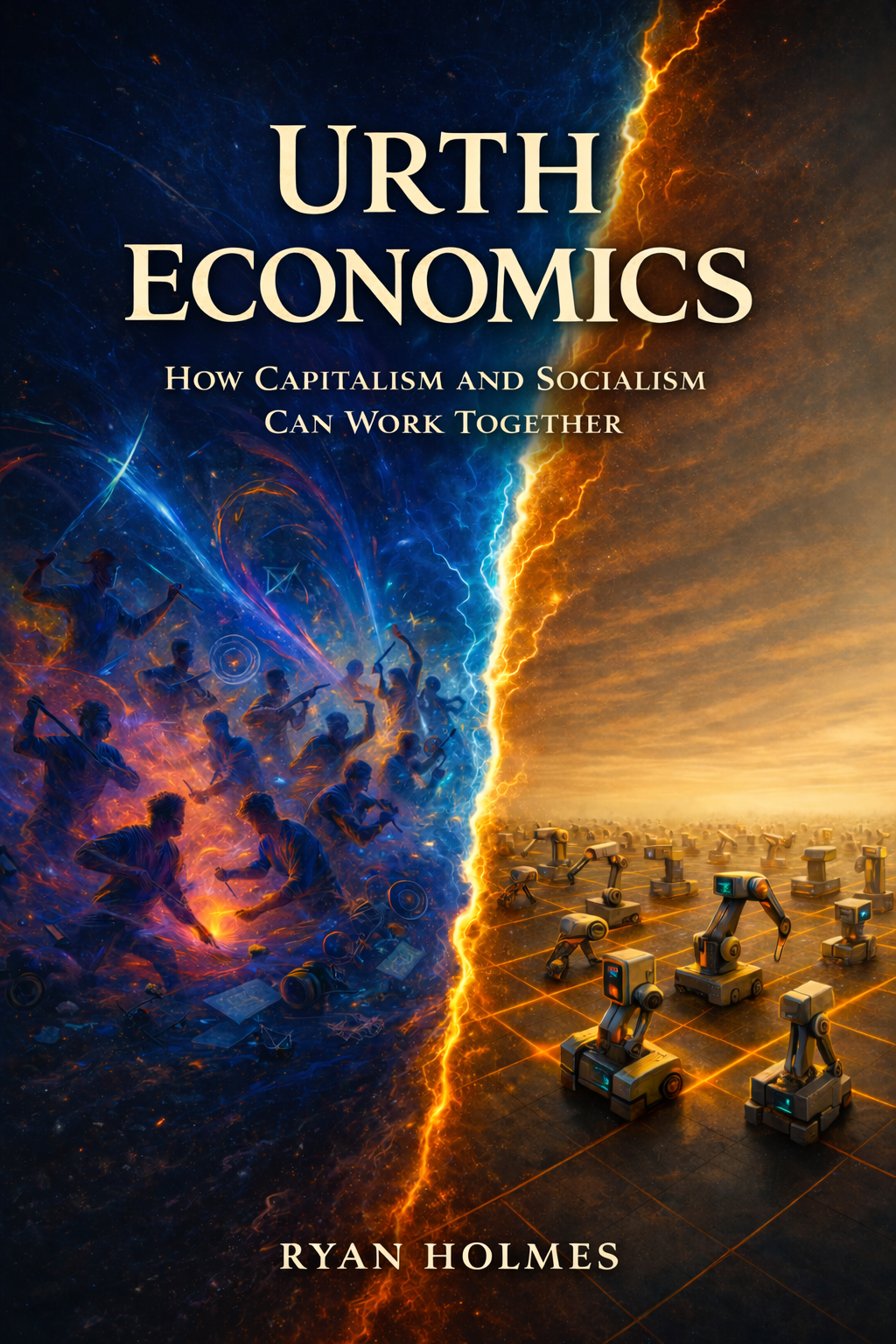
Instead of arguing ideology, Urth Economics focuses on fit. It distinguishes between work that exists to innovate and work that exists to maintain. It shows why competition drives progress in creative sectors but creates waste and fragility in essential systems. It explains why coordination brings reliability in some domains and disconnection in others.
From this distinction emerges a practical framework for organizing the economy without tearing it apart.
Inside the book, you will explore:
Why competition works brilliantly in innovation driven industries and fails quietly in mature ones
How essential systems become fragile when rivalry replaces stewardship
Why centralized control and market absolutism fail for the same structural reason
The Dual Industry Framework, a simple map for aligning structure with function
The Tier 1 Group, a human scaled unit of accountability and coordination
A clear, grounded rethinking of land, housing, and property tax as stewardship rather than punishment
How these ideas fit within the world we already have, without collapse or utopian promises
Urth Economics does not call for the abolition of markets or the expansion of centralized control. It does not promise a perfect system or a final answer. It offers something more useful: a way to understand why familiar solutions keep producing familiar problems, and how those tensions can be reduced by putting the right tools in the right places.
This book is written for readers who are tired of choosing sides and would prefer systems that are easier to live with.
If the economy feels broken even when it is growing, the problem may not be growth itself. It may be that we have been asking one set of tools to do jobs they were never designed to handle.
Why does the economy keep growing while life feels harder to live?
Why do markets create extraordinary innovation in some places and chaos in others?
Why do coordinated systems provide stability in theory but feel distant and rigid in practice?
Urth Economics begins from a simple but often ignored observation: not all work serves the same purpose, and not all systems should be organized the same way.
For decades, economic debate has been trapped in a false choice between capitalism and socialism. Each side points to real failures. Each side offers solutions that work in some contexts and break down in others. The argument never resolves because it asks the wrong question.
This book asks a different one.
Instead of arguing ideology, Urth Economics focuses on fit. It distinguishes between work that exists to innovate and work that exists to maintain. It shows why competition drives progress in creative sectors but creates waste and fragility in essential systems. It explains why coordination brings reliability in some domains and disconnection in others.
From this distinction emerges a practical framework for organizing the economy without tearing it apart.
Inside the book, you will explore:
Why competition works brilliantly in innovation driven industries and fails quietly in mature ones
How essential systems become fragile when rivalry replaces stewardship
Why centralized control and market absolutism fail for the same structural reason
The Dual Industry Framework, a simple map for aligning structure with function
The Tier 1 Group, a human scaled unit of accountability and coordination
A clear, grounded rethinking of land, housing, and property tax as stewardship rather than punishment
How these ideas fit within the world we already have, without collapse or utopian promises
Urth Economics does not call for the abolition of markets or the expansion of centralized control. It does not promise a perfect system or a final answer. It offers something more useful: a way to understand why familiar solutions keep producing familiar problems, and how those tensions can be reduced by putting the right tools in the right places.
This book is written for readers who are tired of choosing sides and would prefer systems that are easier to live with.
If the economy feels broken even when it is growing, the problem may not be growth itself. It may be that we have been asking one set of tools to do jobs they were never designed to handle.